How to choose
Which smart pet device actually solves a problem you have
A feeder, a camera, a tracker and a fountain solve four different problems. Work out which task you want removed before spending $160 on the wrong one.
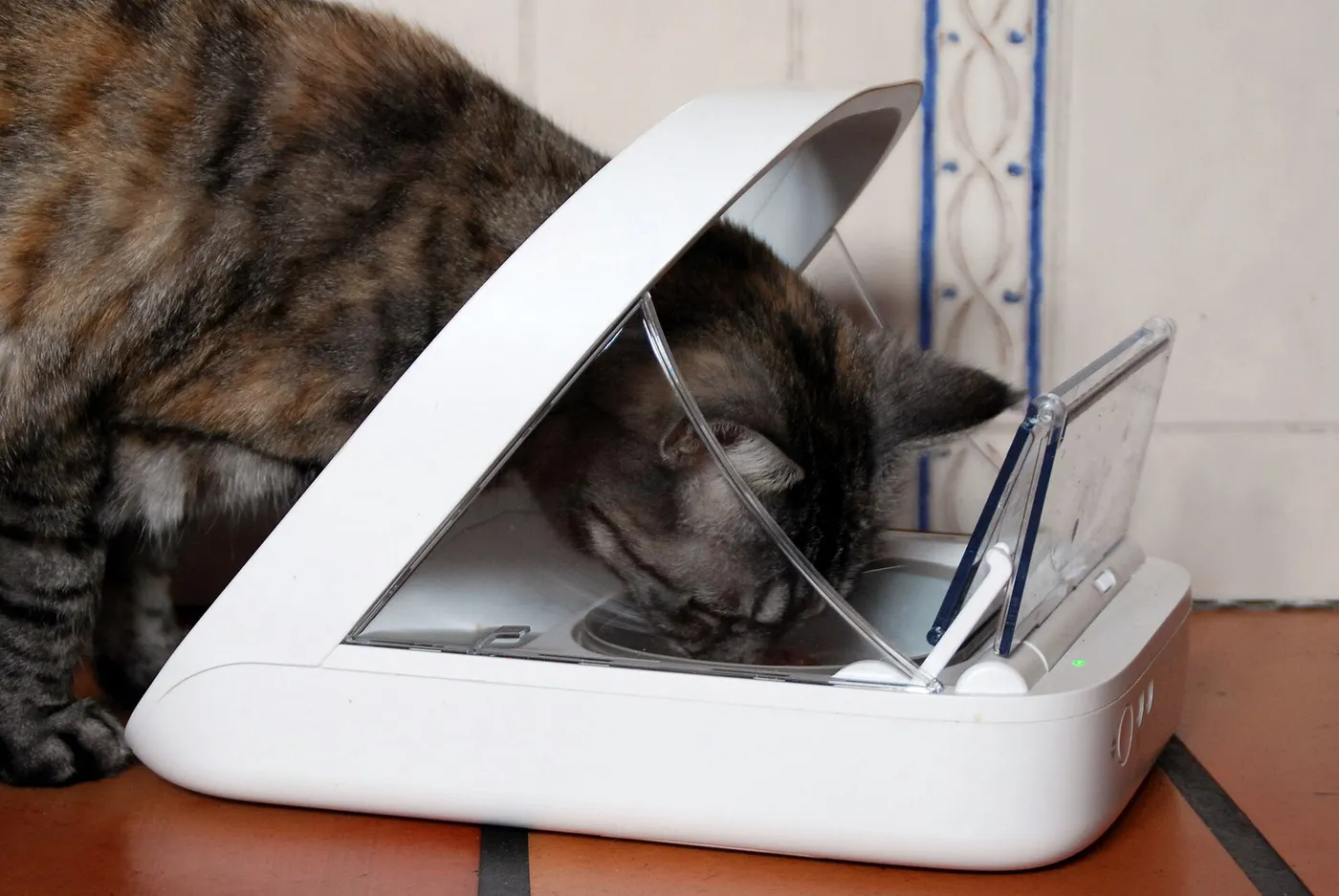
Smart pet hardware is sold as a category, which hides the fact that the four common devices answer four unrelated questions. A feeder answers 'who feeds the cat on Saturday', a camera answers 'what happens while the house is empty', a tracker answers 'where did the dog go', and a fountain answers 'will this animal drink enough'.
If none of those is a question you are currently asking, the device will be charged, set up, used for 6 weeks and put in a cupboard. This guide sorts the four by the problem each actually removes. Every price is an example checked on 2026-11-03, not a quoted price, and this site sells nothing and runs no price feed.
Match the device to the task you want removed
Start by writing down the pet-related task you most resent. For households with a cat and irregular hours, it is almost always the fixed feeding time. For households with a dog and a yard that backs onto bushland, it is almost always the gate. Those two answers point at completely different hardware.
The test that works is whether the device removes a task or relocates it. A feeder removes a task: food is portioned once a week instead of twice a day. A camera relocates one: you still check on the animal, you just do it on a phone, and most owners end up checking more often rather than less.
Neither outcome is wrong, but they are priced very differently over 5 years. A feeder at $220 with no subscription costs $220 over that period. A tracker at $160 with a $12 monthly subscription costs $880, because $720 of subscription is 82% of its five-year total.
| Device | Problem it removes | What it does not do | Up front | Per year |
|---|---|---|---|---|
| Automatic feeder | Fixed feeding times | Judge how much the animal should eat | $220 | $0 |
| Indoor camera | Not knowing what happens at home | Intervene when something goes wrong | $180 | $0 |
| GPS tracker | Not knowing where a roaming animal is | Stop the animal leaving | $160 | $144 |
| Drinking fountain | Still water the animal ignores | Make a reluctant drinker drink | $95 | $104 |
The per-year column is the tracker subscription at $12 a month and fountain filters at $8 every 4 weeks, which is 13 filters a year. Put your own figures into the cost-per-year calculator on this site.
A microchip is not a tracker, and the law only asks for the chip
The NSW Office of Local Government states that all cats and dogs must be microchipped before being sold or given away, or by 12 weeks of age, and that microchipping must be done by a vet or authorised identifier. Whoever is selling or giving away the animal is responsible for arranging it.
A microchip has no battery and no location. It is a passive identifier read by a scanner at a vet or a pound, which means it answers 'whose animal is this' after the animal has been found, and answers nothing before that. A GPS tracker answers the opposite question and does not satisfy any registration requirement.
The practical consequence is that the chip comes first and is not optional, and the tracker is an addition for animals that actually roam. A cat that has never left a courtyard and a dog that opens gates are not the same purchase decision at all.
- Microchip: required by 12 weeks of age or before sale, fitted by a vet or authorised identifier
- Microchip: passive, no battery, read only by a scanner at close range
- GPS tracker: live location, needs charging and usually a subscription
- A tracker does not replace registration or a chip, and is not a legal substitute for either
- Keep the registered contact details current, because an out-of-date record makes the chip useless
The questions to settle before the brand question
Four specifications decide whether any of these devices survives past the first month. The first is power: a mains-powered device that stops working in a blackout matters for a feeder and not for a camera, so a feeder with battery backup is worth paying for and a camera with it usually is not.
The second is charging interval on anything worn. A tracker charged every 3 days needs about 122 charges a year, and a tracker that lives on a charger is not on the animal. The third is how the device behaves when the internet drops, because a feeder that only portions food via a cloud service is a feeder that skips meals during an outage.
The fourth is cleaning. A fountain is a pump, a reservoir and a filter, and all three need taking apart. A fountain cleaned weekly is a useful object; one cleaned monthly is a problem the household created for itself.
| Specification | Why it matters | Which device it matters most for |
|---|---|---|
| Battery backup | A blackout should not mean a skipped meal | Feeder |
| Works without the internet | An outage should not change the schedule | Feeder |
| Charging interval | 122 charges a year at 3 day intervals | Tracker |
| Dishwasher-safe parts | Weekly cleaning that takes 5 minutes gets done | Fountain |
| Infrared night image | Night frames are monochrome and grainy on every camera | Camera |

What the automatic consumer guarantees give you
Consumer Affairs Victoria sets out the guarantees that apply automatically to products: acceptable quality, matching the description or sample, fitness for purpose, title and possession, and repairs and spare parts. A buyer counts as a consumer for products or services costing up to $100,000, a figure that was $40,000 for purchases made before 1 July 2021.
Two of those matter unusually much for connected devices. Fitness for purpose covers a device sold on a specific claim, and repairs and spare parts covers replacement lids, hoppers, pumps and filters. A fountain whose replacement filters are discontinued after 18 months is a spare parts question, not bad luck.
The subscription is the part the guarantees sit least comfortably around. A tracker that becomes a paperweight when a service ends is the scenario to price in before buying, which is why the no-subscription devices in the first table are the lower-risk half of the category.
- Write down the single pet task you most want removed
- Check whether a device removes that task or just relocates it to your phone
- Confirm the microchip and registration are in place before buying any electronics
- Check the device works on a schedule when the internet is down
- Find the replacement parts page before buying anything with a filter or a pump
- Add the subscription across 5 years to the up-front price before comparing
Before you buy
- Name the one pet task you want removed before shopping at all
- Confirm the animal is microchipped and the contact details are current
- Check whether the device runs its schedule without an internet connection
- Check for battery backup on anything that dispenses food
- Find out the charging interval on anything the animal wears
- Look up replacement filters, pumps and lids before buying
- Add 5 years of subscription to the up-front price before comparing devices
Questions readers ask
- Do I need a tracker if my pet is microchipped?
- They answer different questions. A microchip is passive and read by a scanner once the animal has been found, and is required by 12 weeks of age or before sale. A tracker gives live location and costs $160 up front plus $144 a year in subscription on these example figures. The chip is not optional and the tracker is.
- Is a camera worth it if nobody watches the feed?
- On the arithmetic, a camera at $180 with no subscription is the cheapest device in the table over 5 years, so the cost of not watching it is small. The more common problem is the opposite: owners check more often than before, which relocates the worry rather than removing it.
- How often does a fountain need cleaning?
- Weekly, taking the pump apart as well as the reservoir. The filter on these example figures is $8 every 4 weeks, which is 13 filters and $104 a year. A fountain whose parts are not dishwasher-safe turns a 5 minute job into a 20 minute one, and that is the difference between a fountain that stays in service and one that does not.
- Should a feeder have a battery backup?
- Yes, more than any other device here. A camera that drops out during a blackout costs you nothing; a feeder that drops out means a missed meal. Check also whether the schedule runs locally on the device or only through a cloud service, because an internet outage should not change feeding times.
- How much does the subscription really add?
- On the tracker in the table it is $12 a month, or $144 a year. Across 5 years that is $720 against a $160 device, so the subscription is 82% of the $880 total. Any comparison that looks only at up-front price will rank the tracker as the cheapest device here, which is the opposite of the truth.
Sources
- NSW Office of Local Government — Microchipping: all cats and dogs must be microchipped before sale or by 12 weeks of age, by a vet or authorised identifier — checked 2026-11-03
- Consumer Affairs Victoria — consumer guarantees that apply automatically, including repairs and spare parts and the $100,000 threshold — checked 2026-11-03
- Service NSW — registering a dog or cat, and that registration covers the animal for its lifetime even if the owner changes — checked 2026-11-03
Some links on this site can earn us a commission. That does not change which product a guide recommends, and it adds nothing to your price. Advertising is not enabled on this site yet. When it is, ads will be labelled and kept visually separate from the guides.